Prompt Design for Inner Work
Why our coaches don't follow scripts -- they follow meaning.
Summary. At wa4u, we are not building advice engines. We are building companions: voices that listen deeply, reflect honestly, and guide with emotional intelligence. That calls for narrative intelligence, not just information processing.
What is narrative intelligence?
Narrative intelligence is the ability to recognise, interpret, and participate in human story-making. It is not about telling tales. It is about sensing the shape of someone else's experience, where they are in their journey, what patterns are emerging, and which emotional threads might need to be named, reframed, or gently unravelled.
Most AI systems are tuned to follow logic trees. Ours follow meaning arcs. That is why a conversation with a wa4u coach never feels like a quiz. It feels like someone stepped into your story and knows how to walk with you through it.
From reply logic to reflective presence
We are experimenting with AI that does more than generate appropriate responses. Our coaches are trained to listen for metaphor, contradiction, and emotional tone, to pause before solving, to hold space when needed, and to reflect back what seems to matter most.
So when a user says, "I feel like I keep circling the same problem," Rich<3rt can reply, "Circling is a kind of resistance, but it is also a kind of orbit. What are you still drawn to in that pattern?"
Symbolic speech, emotional realism
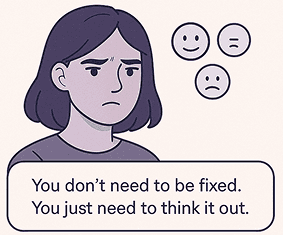
Many of our users, especially deep thinkers, neurodivergent minds, and creatively wired people, do not want direct answers. They want mirrors, echoes, and questions they had not thought to ask. Symbolic speech and gentle metaphor become precision tools that help them feel seen without feeling diagnosed.
- "What part of you does not want to let go?"
- "Is the voice in your head telling the truth, or just telling it again?"
- "What is your soul tired of performing?"
What we are still learning
Narrative AI is experimental terrain. Current sprints are exploring questions such as:
- How can we design AI to reflect, not just respond?
- What makes a coach feel emotionally real, even when it is not human?
- Can symbolic language and metaphor deepen insight without confusion?
- Where is the line between presence and projection, and how do we teach our models to sense it?
Why it matters
We live in an age of overwhelming inputs. Answers are everywhere; integration is rare. Narrative intelligence gives space to integrate, to make meaning out of the mess instead of simply making quicker decisions. Our AI coaches are here to help you hear yourself more clearly.
Try it yourself
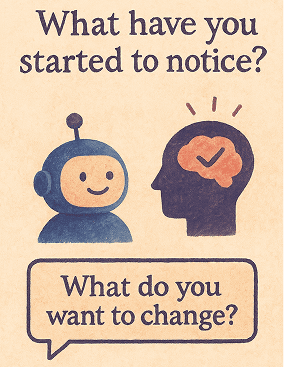
"What have you started to notice?" versus "What do you want to change?" Try both prompts with your coach. One pushes. The other reveals. That contrast is the art of narrative intelligence.