Mood-Aware Adaptive Coaching
How we tune a coach’s voice to your feeling—without labelling you “a problem”
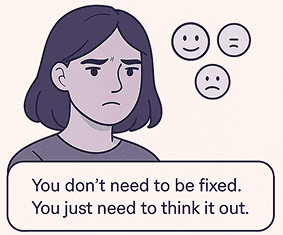
Summary. Most chatbots either ignore emotion or medicalise it. wa4u takes a third path: we read only the affective signals we need, then quietly shift rhythm, imagery, and pacing. You get guidance that feels attuned yet never presumes a diagnosis.
Context and problem definition
Picture venting after a brutal exam. One minute you are low-energy; the next, a bot hands you a depression checklist. Swedish Gen Z testers told us clearly: "Speak softer when I am down, but do not call me severely distressed." Existing solutions either offer generic pep-talks or pathologise normal mood swings. Both miss the sweet spot—acknowledging feeling without judging it.
The lightweight sentiment mesh
Our answer is a lightweight sentiment mesh: a hedged valence-and-arousal score sampled every six to ten turns, not every message. Think "partly cloudy" rather than a psychiatric chart. Direct cues (feeling words, quick check-ins), indirect cues (ellipsis length, emoji density, punctuation energy), and session context feed the mesh. Yesterday’s score is wiped; every chat starts fresh.
Three adaptation levers sit on top. Pace: responses slow and shorten as valence drops. Pronoun distance: more "we" and mirroring when tension rises. Metaphor warmth: concrete imagery for low energy, action verbs when arousal climbs. The mesh stays ephemeral and low resolution—enough to guide tone, never to fix identity.
Application in wa4u
Inside Listen → Clarify → Explore → Adjust → Act, the mesh lives in Adjust. When it detects a low-steady pattern, the system swaps in a softer prompt stack (/explore-tone-softer). When arousal spikes positive, it loads an energising stack (/energise-and-clarify). A guardrail beneath it says: if valence ≤ -0.7 and the hopeless lexicon counter ≥ 3, the coach proposes a human hand-off. Mood steers tone; crisis steers escalation.
Snapshot
| Baseline response | Mesh-aware response |
|---|---|
| "Sure! Let us create a study timetable. First, list your subjects…" | "Got you. Days like this can feel heavier than the textbooks. Let us breathe, then pick one subject that feels least overwhelming. Sound okay?" |
Same user goal—"Need study tips, feeling awful today." The content stays practical; the rhythm and imagery soften.
Open questions
- Does sampling every six turns miss micro swings that matter?
- How reliable are emoji-based inferences compared with explicit feels-checks?
- At what point does tone-tuning feel uncanny or clinical in disguise?
Conclusion
Tone is the first tool of psychological safety. Letting mood steer tone—but never define the person—keeps conversation human, hopeful, and stigma-free. Tools, not rules—growth, not pressure.